
SiC Materials for TCB Nozzles: Selection and Precision Machining
Silicon carbide (SiC) is a potential material for precision components used in semiconductor manufacturing equipment, including selected thermal compression bonding (TCB) and wafer-handling applications. When evaluating SiC for a TCB nozzle or bonding-head component, engineers should consider the component's function, material grade, dimensional tolerances, surface finish, and operating environment. HMT supplies SiC wafer materials and crystal substrates for semiconductor research and manufacturing, while finished nozzle fabrication requires separate evaluation of the component design and machining process.
What Is a TCB SiC Nozzle?
Thermal compression bonding is a semiconductor packaging process that joins aligned components using controlled temperature and pressure. Depending on the equipment design, a TCB bonding head may incorporate heating, workpiece handling, alignment, and vacuum-based holding functions.
The terms TCB nozzle, bonding nozzle, and bonding head do not necessarily describe identical components. A nozzle may refer to a workpiece-contacting or vacuum-handling part, whereas a bonding head can describe a larger assembly incorporating multiple mechanical and thermal functions.
For advanced packaging applications, dimensional stability and repeatable workpiece positioning are important evaluation criteria. The required specifications depend on the bonding system, die dimensions, contact geometry, and process conditions.

Why Consider Silicon Carbide for Precision Components?
Silicon carbide is known for its high hardness, wear resistance, chemical stability, and thermal properties. These characteristics make SiC an established material family for demanding industrial and semiconductor equipment applications, although the suitability of a particular grade depends on its composition and manufacturing route.
For precision components, material selection should be based on measurable engineering requirements rather than hardness alone.
Key considerations include:
-
Wear resistance: Evaluate whether the component must withstand repeated handling cycles or contact with other surfaces.
-
Thermal behavior: Assess thermal conductivity, thermal expansion, and temperature-dependent dimensional stability.
-
Chemical compatibility: Confirm resistance to the process gases, cleaning agents, and other chemicals encountered during use.
-
Mechanical integrity: Consider fracture resistance, component geometry, wall thickness, and stress concentration.
-
Surface quality: Specify roughness, edge condition, and contact-surface requirements according to the actual application.
Single-Crystal SiC Wafer vs. Engineering Ceramic SiC
One of the most important decisions is identifying which type of SiC material the component manufacturer actually needs.
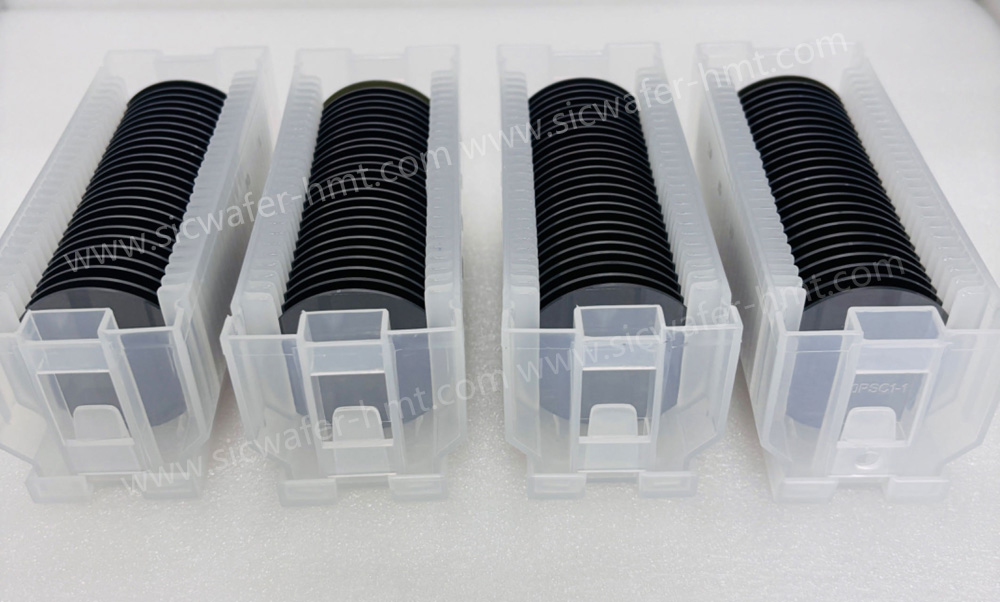
Semiconductor-grade single-crystal SiC wafers are manufactured primarily as substrates for semiconductor device fabrication. Their key specifications may include crystal polytype, conductivity type, resistivity, orientation, thickness, surface finish, and defect characteristics.
Engineering ceramic SiC components, by comparison, may be manufactured using different ceramic processing routes and are selected according to mechanical, thermal, chemical, and dimensional requirements.
These material categories serve different purposes. A polished single-crystal SiC wafer should not automatically be considered a suitable blank for a machined TCB nozzle. The buyer and component manufacturer must first establish the required material form, component geometry, and manufacturing route.
HMT provides SiC crystal and wafer materials for semiconductor-related applications. Customers evaluating upstream material for a specialized component should provide the intended application and technical requirements so that material suitability can be reviewed before production.
Sourcing SiC Materials for TCB Component Development
Companies developing TCB nozzles or bonding-head components may need two different supply-chain partners: an upstream SiC material supplier and a precision machining manufacturer.
The upstream supplier provides material in the appropriate form and specification. The machining manufacturer converts a suitable blank into the required component and verifies the finished geometry.
HMT supplies SiC wafer and substrate materials in configurations that depend on product availability and technical requirements. For material evaluation, customers should specify the required diameter, material type, thickness, grade, surface condition, and intended downstream process.
If the application requires a dense engineering ceramic rather than a semiconductor-grade single-crystal wafer, that distinction should be confirmed before requesting a quotation. This helps prevent unnecessary processing costs and ensures that the selected material matches the component manufacturer's production route.
To evaluate a potential material supply arrangement, provide the component drawing or preliminary dimensions, the target material specification, the expected quantity, and the critical inspection requirements.
Conclusion
Selecting SiC for a TCB nozzle or bonding-head component requires more than choosing a hard material. Buyers must distinguish semiconductor-grade single-crystal SiC from engineering ceramic SiC, establish the component's functional requirements, and verify that the material and machining route can meet the specified tolerances.
HMT supplies SiC wafer and substrate materials for semiconductor-related applications. Material suitability for a specific TCB component should be confirmed through a technical review of the required material form, geometry, and downstream manufacturing process.
Frequently Asked Questions
1. What is a TCB SiC nozzle?
A TCB SiC nozzle is a term used to describe a silicon-carbide component associated with certain thermal compression bonding or workpiece-handling systems. Its exact function and geometry depend on the equipment design, so buyers should confirm the component drawing before sourcing.
2. Why is SiC considered for semiconductor equipment components?
SiC offers high hardness, wear resistance, chemical stability, and useful thermal properties. Whether it is suitable for a particular component depends on the SiC grade, manufacturing route, operating environment, and required tolerances.
3. Can a semiconductor-grade SiC wafer be machined directly into a TCB nozzle?
Not necessarily. Semiconductor-grade single-crystal wafers and engineering ceramic SiC blanks have different material characteristics and intended manufacturing routes. The component manufacturer should confirm the required material form before a wafer is selected.
 E-mail: kim@homray-material.com ; tina@homray-material.com
HMT Gallium Nitride (GaN) Wafer Website: www.ganwafer-hmt.com